Uluwatu Rental Demand and Tourism: What Drives Occupancy and Rates
A villa only earns when it is booked, so before you buy for rental income you should understand the demand that fills the calendar. Uluwatu has one of the clearest demand stories in Bali: a large and growing flow of visitors, a specific kind of guest who stays longer and pays more, and a lifestyle they come specifically for.
This guide sets out what actually drives rental demand on the Bukit, how occupancy and nightly rates are built, how the seasons move, and why amenity-rich estates hold their rate when weaker villas discount.
The demand base: tourism at scale
Rental demand starts with the size of the pool of visitors, and Bali's is large. The island draws more than 6 million international tourists a year, a flow that supports rental yield across its prime areas and that has recovered and grown in strength. Uluwatu takes a premium slice of that flow, the visitor who comes for the cliffs, the surf and the design-led scene rather than the budget crowd.
That scale is the floor under the market. It is why villa demand on the Bukit is structural rather than seasonal fashion, and why owners here are not relying on a single source of guests. For how that demand feeds into the wider investment case, see why Uluwatu is Bali's fastest-growing luxury market.
A large visitor base also protects an owner from the thing that sinks rental returns elsewhere, which is dependence on a narrow market. Bali draws guests from across Asia, Australia, Europe and beyond, so a soft patch in one source market is cushioned by the others. The demand is diversified by origin and by purpose, from surfers and honeymooners to remote workers and families, which keeps the calendar from being hostage to any single trend.
The guest who matters: the design-led long-stay visitor
Headline tourist numbers are only half the story. What drives villa income is the type of guest, and Uluwatu attracts a particular one: the design-led, active, long-staying visitor. This is the traveller who books a villa for a fortnight or a month rather than a hotel room for three nights, who works remotely between surf sessions, and who chooses the Bukit for its architecture and its lifestyle.
This guest is worth more than a short-break tourist on two counts. They stay longer, which lifts occupancy and lowers the turnover cost per night, and they pay more for a villa that matches their taste. A design-led home in a well-run estate is exactly what they are searching for, which is why quality of build and management translates so directly into rental performance here.
Length of stay is the quiet economics of this. A villa turned over every two nights spends a large share of its revenue on cleaning, check-ins and the gaps between bookings. A villa taken for two weeks or a month earns a steadier income with far less friction, and it tends to attract a guest who treats the home with more care. This is why the long-stay market is so valuable to an owner, and why a villa positioned for it, rather than for high-churn weekend tourism, often returns better even at a similar headline rate.
Thinking about Uluwatu? Our team can walk you through availability, pricing and the ownership structure at Ulu Art Bay.
Contact usSign upWhat lifestyle actually pulls them in
Demand is not abstract, it attaches to specific things people come to do. Uluwatu offers a dense run of them in a small area, which is why guests fill their days without leaving the peninsula.
- World-class surf, from the famous reef at Uluwatu and Padang Padang to the friendlier breaks at Bingin, Balangan and Dreamland.
- A concentration of clifftop and beachfront clubs, from Ulu Cliffhouse and Savaya to Sundays Beach Club, built for the sunset hour.
- A strong dining and wellness scene, from warungs and cafes to spas, saunas and ice baths.
- Culture at the edge of it all, from Uluwatu Temple to the Kecak fire dance at sunset.
A villa a few minutes from the best of this earns better rates and longer stays, because the guest is paying for proximity to the experience as much as for the bedroom. We go deeper into the scene in our guides to the best beach clubs and the best surf spots in Uluwatu.
The point for an owner is that none of this is seasonal froth. The surf, the temple and the coast are permanent features, and the beach club and dining scene keeps deepening rather than fading. A villa near the centre of it is attached to a lifestyle that does not go out of fashion, which is what makes the rental demand durable rather than a bet on this year's trend.
How occupancy and nightly rate combine
Rental income is the product of two numbers: how many nights the villa is booked, occupancy, and how much it earns per booked night, the nightly rate. A villa can underperform on either. High occupancy at a weak rate leaves money on the table, and a strong rate with poor occupancy leaves the calendar empty. The job of good management is to hold both at once.
At Ulu Art Bay the collections are modelled at 60 to 80% occupancy, which supports a projected net rental yield of 8 to 11%. Net is the word that matters, because it is after operating costs, not the gross a booking site shows. We break the gross to net gap down in Uluwatu villa investment and ROI.
Why management decides the outcome
Two identical villas can earn very differently depending on who runs them. Pricing the calendar dynamically, maintaining the villa to a standard that earns five-star reviews, and keeping the channels full are specialist jobs. This is why an owner-managed villa left to a part-time caretaker tends to underperform a professionally run one, and why we keep rental management in-house. The detail is in villa management and rental income in Bali.
Seasonality: the shape of the year
Uluwatu's year has a rhythm. The dry season, roughly April to October, is the high season for both surf and visitors, with the strongest demand around July and August. The New Year period is a second clear peak. These are the windows when rates are highest and the best villas book out well in advance.
The shoulder and wet-season months are softer, but the Bukit does not go quiet the way a single-season resort does. The long-stay and remote-working guest travels outside the peaks, and the surf keeps drawing people through much of the year. A villa that leans on the long-stay market, rather than only on peak-week tourists, smooths the calendar and defends its annual occupancy.
This is why the yield model at Ulu Art Bay uses a 60 to 80% occupancy band rather than a peak-season figure. A sensible projection assumes a full year with real variation in it, not a July that runs all twelve months. When you assess any villa's rental case, ask what season the occupancy assumption reflects. A number that only holds for the high weeks is not an annual yield, it is a best case dressed up as a plan.
How amenity-rich estates hold rate
The clearest divide in the Uluwatu rental market is between villas that compete on price and villas that compete on experience. When demand softens in the shoulder season, a standalone villa with nothing to distinguish it has one lever left, which is to cut the rate. An amenity-rich estate does not have to, because it is selling something a price cut cannot replace.
Ulu Art Bay is built for exactly this. Its private Recreation Club gives guests professional floodlit padel courts, a wellness spa with a traditional hammam, saunas, a jacuzzi and a cold bath, yoga and Pilates studios, an art gallery, a Mediterranean fine-dining restaurant and a boutique café, with in-villa dining from the estate kitchen. That is a reason to book at rate in a quiet week, not a discount war. This is how amenity-led estates defend both occupancy and nightly rate across the year.
What drives the nightly rate a villa can hold
Occupancy fills the calendar, but the rate decides how much each night is worth, and the rate is set by a short list of things a guest can see and feel. Understand them and you understand why two villas in the same area command very different prices per night.
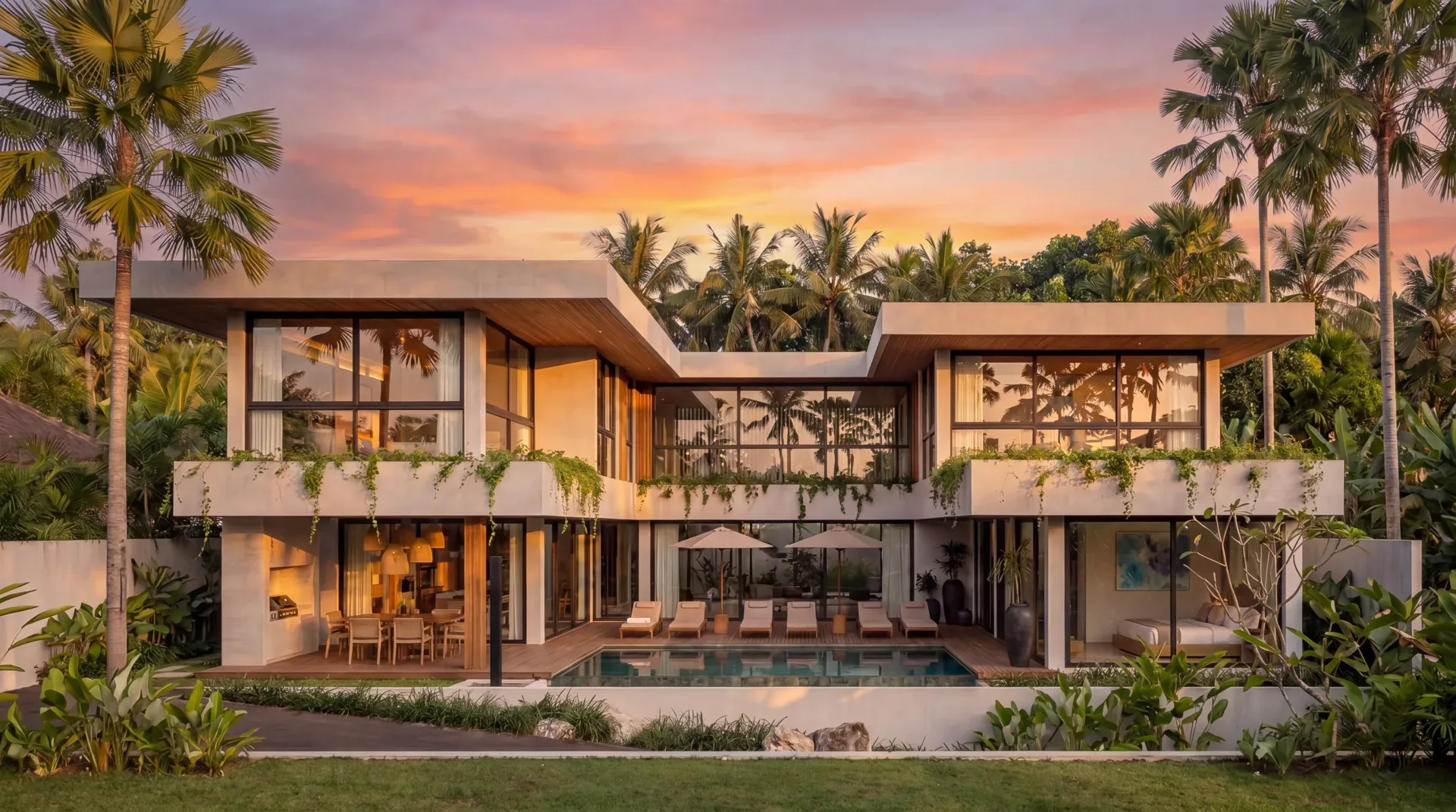
- The view and the setting. A genuine clifftop or ocean outlook is the single strongest rate driver on the Bukit.
- The design and the finish. A coherent, photogenic home earns more than a generic one, because it sells the stay before the guest arrives.
- The amenities, on the villa and across the estate, from the pool to a wellness spa and padel courts.
- Proximity to the surf, the beach clubs and the dining that guests come for.
- Service and management, which turns a good villa into a five-star review and a repeat booking.
Ulu Art Bay is positioned on every one of these: a clifftop estate minutes from Bingin, villas by SUKYF in three design languages, a private Recreation Club, and in-house management. That is a rate-defending combination rather than a single feature, which is what lets a villa hold its price when a thinner offer has to drop. For the full return picture these rates feed into, read Uluwatu villa investment and ROI.
What rising infrastructure does to demand
Demand is not static, and access shapes it. New roads and the ongoing airport expansion are improving how easily visitors reach the Bukit, and easier access widens the pool of guests who will consider a stay. Ngurah Rai Airport is around 40 minutes from the estate, and the journey has become steadily more comfortable as the roads improve.
Better access does two things for an owner. It lifts the ceiling on demand by bringing more visitors within reach, and it supports the longer-term appreciation that sits alongside the rental return. The two reinforce each other, which is part of why Uluwatu has repriced upward.
It is worth keeping the two returns distinct even here. Rising access and rising demand lift the rate and occupancy you can achieve now, and they also lift what the villa is worth when you sell. A rental buyer is really buying both, an income stream and an appreciating asset, and the same infrastructure story improves each of them. We separate the income and the appreciation carefully in our investment and prices guides so you can judge them on their own terms.
What this means if you are buying to let
Put the pieces together and the rental case for Uluwatu is coherent. A large and growing visitor base gives you a deep demand pool. The design-led long-stay guest gives you longer bookings at stronger rates. A dense lifestyle gives guests a reason to choose the Bukit over anywhere else. And an amenity-rich, well-managed estate lets you hold rate through the softer months instead of discounting.
A villa like Ulu Art Bay, minutes from Bingin and anchored by its own Recreation Club, is built to sit on the right side of every one of those drivers. It is freehold, so it holds its value, it is designed to earn the rate, and it is managed in-house so the income arrives without becoming your job.
The honest caveat is the one we repeat across these guides: the 8 to 11% net yield and the 60 to 80% occupancy are model estimates, not guarantees, and real performance depends on the market and the management. We would rather show you the model and the assumptions than hand you a headline. If you want the occupancy and rate assumptions behind a specific collection, contact our team or sign up to receive the next release and the full model.
Frequently asked questions
Is there strong rental demand for villas in Uluwatu?
Yes. Bali draws more than 6 million international tourists a year, and Uluwatu takes a premium slice of that flow, especially the design-led, long-stay visitor who books villas for weeks rather than hotel rooms for nights.
What occupancy can a villa in Uluwatu achieve?
Ulu Art Bay's collections are modelled at 60 to 80% occupancy, which supports a projected net rental yield of 8 to 11%. Actual occupancy depends heavily on management, location and amenities.
When is peak season in Uluwatu?
The dry season, roughly April to October, with the strongest demand around July and August, plus a second peak over the New Year period. The long-stay market helps fill the shoulder months.
Do amenities really affect rental income?
Yes. Amenity-rich estates command higher nightly rates and hold occupancy when standalone villas discount. Ulu Art Bay's private Recreation Club is a core reason guests book at rate across the year.