How Art Villas Bali Builds: Design, Construction and Quality Under One Roof
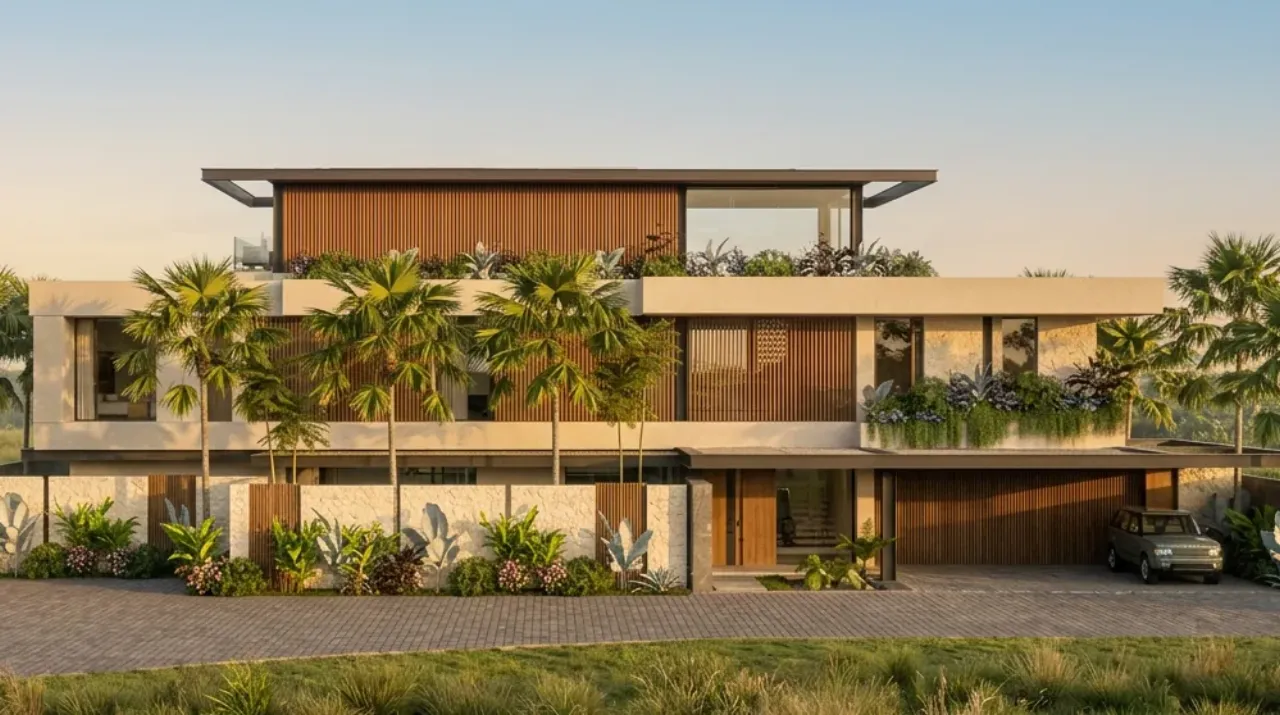
The gap between a beautiful rendering and a villa you would actually want to own is built, not drawn. It is closed by who designs the house, who builds it, what it is made of, and how closely the two are held together through two years on site. A lot of Bali projects outsource those links to whoever is cheapest and hope they line up. Art Villas Bali does not.
This is how we build: a single international architecture studio, a long-established Bali contractor, a specific and durable palette of materials, and every discipline from design to legal structuring to long-term management kept under one roof. The point of the model is simple. When one team owns the whole chain, nothing falls through the cracks between the drawing and the key.
One roof, not a chain of subcontracts
Most villa buyers discover too late that the entity selling them a home, the one designing it, the one building it and the one managing it afterward are four different companies with four different incentives. When something goes wrong, each points at the others. Our model is built to remove that gap. Architecture, construction, legal structuring, sales and long-term management sit under one roof, with one point of accountability.
Art Villas Bali, founded in 2021, is the developer and curator that holds those threads together. The portfolio runs to more than 21 freehold villas and a value above 30 million US dollars, built for more than 50 international clients. That track record is the product of the model, not a coincidence beside it. When the same organisation that designed a detail is responsible for building it and then living with it through years of rental management, the detail gets done properly.
The practical effect is that accountability never leaves the building. A subcontracted chain lets each party close out its contract and walk away, so a flaw that surfaces a year later belongs to nobody. Under one roof the same team that drew a junction, poured it and will rent the villa out still owns that junction long after completion. That continuity is the quiet engine behind the standard, and it is why we treat the model itself as the product.
Design: SUKYF
The architecture comes from SUKYF, a studio founded in Madrid in 1995 and led by architect Felipe Gonzalez, with built work across more than fifteen countries. That international experience matters, because designing for a clifftop in the tropics is not the same as designing for a European plot, and a studio that has worked across many climates and briefs brings a discipline that a purely local practice may not.
SUKYF does not hand buyers a single repeated template. At Ulu Art Bay the villas are offered in three design languages the buyer chooses from: Minimal Modern, which is light, pure and geometric, Mediterranean Luxe, in textured stone, linen and bronze, and Bohemian Artist, built around colour, movement and handcrafted detail. The architecture and the art are resolved together rather than one decorating the other, which is the idea behind the project's name, where art becomes habitat. We explore that further in the art-led villa.
Thinking about Uluwatu? Our team can walk you through availability, pricing and the ownership structure at Ulu Art Bay.
Contact usSign upConstruction: Lexio
A design is only as good as the hands that build it. Construction at Ulu Art Bay is delivered by Lexio Construction, a Bali contractor with more than 40 years of experience, led by Leo Singgih Gunawan. Four decades of building on the island is not a line on a profile. It is accumulated knowledge of local ground, weather, labour and supply that keeps a complex clifftop build on schedule and to standard.
That local depth paired with SUKYF's international design is the combination that makes the model work. The architect sets the intent, the contractor knows how to realise it in this specific place, and because both answer to the same developer, the loop between drawing and site stays tight. The estate is a 24-month build with completion in 2028, a timeline that only holds when design and construction are genuinely coordinated rather than thrown over a wall.
Materials that age well
A villa's longevity lives in its materials. The palette across our homes is chosen to look better with age rather than worse, and to belong to the clifftop landscape rather than fight it.
- Travertine, a natural stone with depth and warmth underfoot that wears in rather than out.
- Timber screens that filter light and heat, giving privacy and shade while keeping a space connected to the air.
- Hand-laid stone, where the craft is visible in the surface and no two walls are quite identical.
- Linen, for a soft, breathable texture suited to the climate.
- Bronze, for fittings and detail that develop a patina and a sense of permanence over time.
These are not finishes chosen from a catalogue for a photograph. They are materials that reward touch and time, which is the difference between a villa that looks new for a season and one that looks considered for decades. The restraint of the black, white and grey architecture lets the material itself carry the warmth.
There is a practical logic underneath the aesthetic one. In a humid, coastal, high-use environment, cheap finishes fail quickly and date faster, and a rental villa takes more wear in a year than a private home takes in several. Natural stone, solid timber and bronze are chosen partly because they survive that use and read better for having lived through it. Choosing materials that age well is a maintenance decision and a resale decision as much as a design one, which is another reason it sits inside the same organisation that will later manage the home.
Quality control through the build
Quality is not a final inspection, it is a hundred small decisions made correctly along the way. Because design, construction and management sit together, the standard is held continuously rather than checked once at the end. The team that will eventually rent and maintain the villa has a voice while it is still being built, which changes the choices made on site in favour of what actually lasts.
The commercial structure reinforces the discipline. Reservation is a 10% deposit, and the off-plan price climbs across four defined construction phases to a +34.8% uplift at completion. A phased build with milestones is a build that can be checked at each stage rather than taken on trust at the finish. It aligns everyone, buyer, developer and contractor, around progress that is visible and verifiable.
When the team that designs a villa also builds it and then manages it, quality stops being a final inspection and becomes a standard held the whole way through.
The partners behind the build
A build of this scale rests on named, accountable partners rather than anonymous subcontractors. Design is SUKYF, construction is Lexio. The legal structure that makes a villa freehold for a foreign buyer is handled by specialist partners, ILA Global and Hoot Legal, who structure and register ownership through a PT PMA that holds HGB title with the state land agency. The investment platform is Life Is Good Group, and banking runs through established institutions.
This is the opposite of a one-person operation improvising as it goes. Each discipline is held by a partner with a track record in it, and the developer coordinates them so the buyer deals with one team rather than six. If you want to understand the ownership side of that structure, our guide to why Ulu Art Bay is Uluwatu's standout freehold project sets it out in full.
Why Bali rewards this discipline
This model is not just a preference, it is a response to where it is being built. Bali is one of the great places in the world to own a villa and one of the harder places to build one well. The climate is demanding, the clifftop ground is complex, supply chains can be unpredictable, and the gap between a project that is coordinated and one that is improvised shows up fast once construction starts. A studio that has worked across more than fifteen countries and a contractor with more than 40 years on the island are precisely the pairing that absorbs that difficulty instead of passing it to the buyer.
It also protects the thing a buyer is actually paying for, which is the view and the setting. Building on a finite clifftop above the Indian Ocean means working carefully with the land rather than against it, so the villa sits into its site and keeps the outlook that gives Uluwatu its value. That is a design and engineering problem solved together, not a finish chosen at the end, and it is why the one-roof model matters more here than it would on an easy inland plot.
The commercial case rides on the same discipline. Uluwatu is one of Bali's strongest-appreciating prime zones, but appreciation only accrues to a villa that is actually well built and well located. A beautiful rendering on poor construction is a liability, not an asset. The build quality is what turns the location's potential into a real return, which is why we treat construction as central to the investment rather than a line item beneath it.
The people behind it
A model is only as good as the people running it, so it is worth naming them. Art Villas Bali is led by Vincenzo F. Martorana Genuardi as Founder and CEO and Sebastien Daignes as Co-Founder and CFO, with Giorgio Terranova as Head of Investments, Bruno Szabadkai as Head of Technology, and Indra Mandhala Putra overseeing notary work and land rights. On the construction side, Lexio is led by Leo Singgih Gunawan, and the architecture is led by Felipe Gonzalez at SUKYF.
Named, accountable leadership across each discipline is the opposite of the anonymous operator that so much of the market runs on. When the person responsible for investments, the person responsible for land rights and the person responsible for the build can all be pointed to, a buyer knows who answers for the result. That transparency is itself a form of quality control, and it is part of why more than 50 international clients have bought into the portfolio.
From site to move-in
The build does not end at a finished shell. Every villa is sold fully furnished and move-in ready, which means the same standard that governs the architecture carries through to the furniture, the fit-out and the final styling. That continuity is only possible because furnishing sits inside the same organisation as design and construction rather than being contracted out at the end. We explain what that delivery really involves in turnkey and fully furnished delivery.
The through-line of the whole model is this: a house is only as good as the coordination behind it, and coordination is only reliable when the people responsible answer to the same team. That is how Art Villas Bali builds, and it is why the villas hold the standard they show in the renderings.
See how it is built
The clearest way to judge a builder is to look closely at a finished home and at how it was put together. If you want to walk through the design languages, the material palette and the construction timeline for a specific villa, look at Ulu Art Bay or read how the same thinking shapes wellness architecture across our homes.
When you are ready to go deeper, contact our team and we will take you through the drawings, the partners and the build phase by phase, or sign up to follow the estate as it rises toward its 2028 completion.
Frequently asked questions
Who designs and builds Art Villas Bali villas?
Design is by SUKYF, an architecture studio founded in Madrid in 1995, led by Felipe Gonzalez, working across more than fifteen countries. Construction is by Lexio Construction, a Bali contractor with more than 40 years of experience, led by Leo Singgih Gunawan. Art Villas Bali, founded in 2021, develops and coordinates both.
What materials are used in the villas?
The palette is chosen to age well: travertine, timber screens, hand-laid stone, linen and bronze. These are materials that develop depth and patina over time rather than looking dated after a season, set against a restrained black, white and grey architecture.
Why keep all disciplines under one roof?
When design, construction, legal structuring, sales and long-term management sit together, there is one point of accountability and nothing falls through the gaps between four separate companies. The team that will manage a villa has a voice while it is still being built.
How long does a villa take to build?
Ulu Art Bay is a 24-month build with completion in 2028. The off-plan price climbs across four defined construction phases, so progress is milestone-based and verifiable at each stage rather than taken on trust at the finish.